
Agents, fraud and a 300-page invoice: Who owns it when payments go wrong?
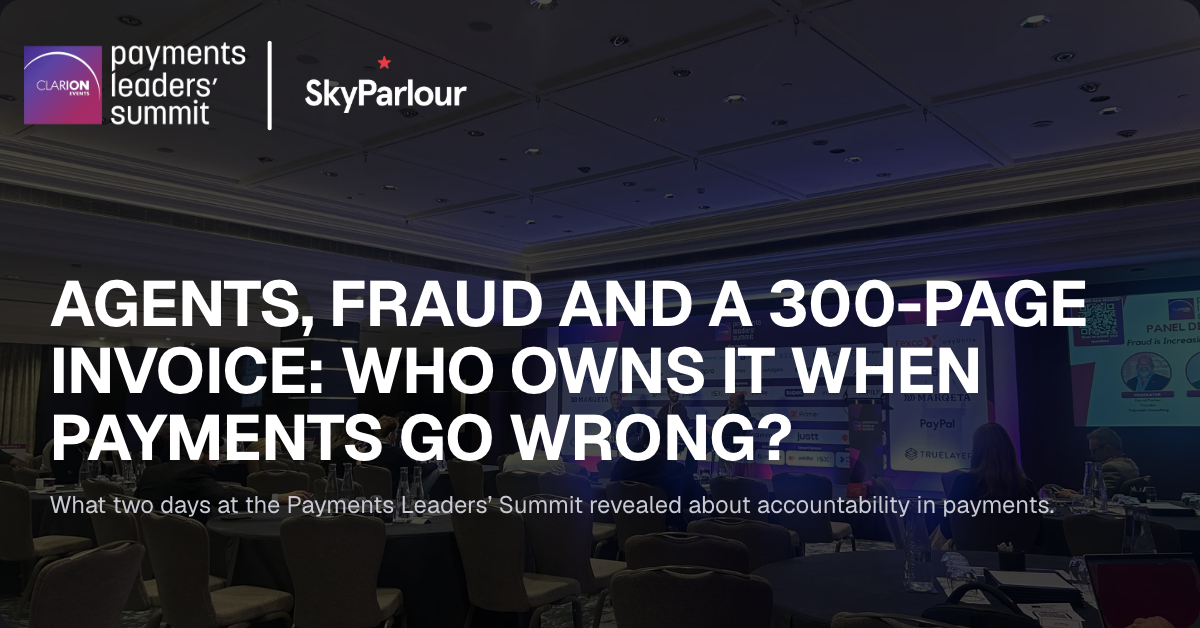
Following two days at The Payments Leaders’ Summit UK in London on 20 - 21 October 2026, George Iddenden from SkyParlour shares some of the key themes, discussions and findings that stood out across the summit.
Merchants, providers, regulators and consultants kept coming back to one question: when something goes wrong, who owns it?
Agents: the plumbing, not the promise
Agentic commerce got the most airtime, but the room was more interested in the plumbing than the promise.
UK open banking passed one billion payments in July 2026, and the first wave of commercial variable recurring payments went live in June. Wave Two, which covers general ecommerce, still isn’t finalised.
Agents start around 3% of payments today, and trust is holding them back. Consumers would cap an agent’s spending at about £177 on average, and a quarter would stop using one if a purchase were hard to dispute.
Four gaps came up again and again: agent identity, delegated consent, faster delivery of Wave Two, and who’s liable when it’s an agent that gets tricked rather than a person.
Travel showed why this matters. Airlines already let trusted human agents sell on their behalf, but a rogue bot could book every seat on every flight before anyone noticed. The advice was to start small, with bags and seats before £10,000 holidays.
Every agent transaction should also show who started it, whether the agent is genuine, and whether it stayed within the customer’s limits.
Fraud: whack-a-mole
Domestic APP scams are falling under the reimbursement rules, but international ones are rising, and every new defence weakens as fraudsters adapt.
Mobile networks are an under-used source of warning signs. One study found that in up to 70% of scam payments, the victim was on a phone call as the money left their account.
Around 80% of scams are thought to start on social media, so the strongest call was for compulsory data sharing between banks, telcos and big tech.
Stopping fraud has a cost too, so businesses should measure the genuine customers they turn away as well as the fraud they stop.
Data: three languages and a 300-page invoice
Every party in a payment speaks its own data language, and the merchant is left to reconcile them all. Fix that and the savings follow.
One merchant recovered around $20 million in nine months through simple fallback routing.
Another found one of its providers charging 20 basis points more than the other, moved 90% of its traffic, and the extra cost was gone within a day.
One of the UK’s largest transit networks handles up to eight million card transactions a day. Its acquirer invoice runs to roughly 300 pages a month and still isn’t detailed enough to show what a single tap costs.
The homework was simple: follow one payment from acceptance to your bank account and work out what it cost.
Buy now, pay later grows up
Buy now, pay later isn’t going anywhere.
Half of shoppers planned to use it to spread the cost of Christmas, and people of every age now use it.
New regulation is seen as building consumer confidence, as long as underwriting stops unaffordable purchases from looking affordable.
Who owns it?
The summit didn’t settle where liability sits for agent payments, how far big tech should be on the hook for scams, or when Wave Two arrives.
But the answers are taking shape.
Agents need an identity that travels with every transaction. Fraud prevention needs more shared data. Merchants need to see a payment all the way from tap to bank account before they can manage its cost, let alone win investment for it.
As the opening address put it, ask what problem you’re solving, what has to work behind the scenes, and who is accountable when it doesn’t.
Written by George Iddenden at SkyParlour, following The Payments Leaders’ Summit UK, October 2026.