

TIS Treasury Team’s Guide to AI-Ready Cash Forecasting - How Treasury Teams Can Move from AI Curiosity to AI Confidence
)
The Treasury Team’s Guide to AI-Ready Cash Forecasting: How treasury teams can move from AI curiosity to AI confidence by building the right foundations, understanding the changing role of the treasurer, and deploying AI where it delivers real value.
About This Guide
There is no shortage of enthusiasm for AI in treasury. CFOs are prioritizing it. Leadership teams are increasingly demanding it. Vendors are rapidly embedding AI capabilities into their offerings. But when treasury teams sit down to act on that enthusiasm, many discover they are stuck. Not because the technology isn’t ready — but because their organizations aren’t. Data is fragmented. Skills are scarce. Governance is undefined. And the gap between “we’re interested in AI” and “we’re getting value from AI” turns out to be much wider than expected. This guide is designed for treasury teams caught in that gap.
It is structured around three key questions:
- Are treasury teams ready for AI — and what does “ready” actually mean?
- How does AI change what treasurers do, and what should they continue to own?
- Where does AI deliver real value in cash forecasting, and how should treasury teams get started?
The guide draws on recent research, conversations with treasury professionals, and TIS’s experience supporting finance teams across industries to answer these questions as practically as possible.
If 2025 was the year treasury teams talked about AI, 2026 is the year they need to act on it.
A. The AI Moment in Treasury
Something shifted in treasury in 2025. AI evolved from a new topic on conference agendas into a line item in budget conversations. The question stopped being:
“Should treasury teams look at AI?” and became: “Why haven’t organizations moved faster?”
The numbers reflect this shift.
- 58% of finance functions now use AI - up from 37% in a single year
- 79% of CFOs plan to increase AI budgets
- 96% of treasury leaders say AI is now a strategic priority
Despite the momentum, most treasury teams are still trying to move from pilot to production.
They remain caught between legacy systems that can’t deliver and new tools that don’t yet fit existing workflows.
“If 2023 and 2024 were spent talking about AI in finance, 2025 was the year of trying to make it real — and discovering just how hard that is. 2026 will demand a new approach.” — Charles Bennett, Chief Product Officer, TIS
The Adoption Gap Is RealThe headline adoption numbers are encouraging, but the deeper reality is more complicated.
Many organizations are running AI pilots. Few have successfully scaled them.
The distance between a proof of concept and an AI capability that fundamentally changes treasury operations is significant.
The reasons are remarkably consistent across industries and company sizes:
- Data is fragmented
- Systems are disconnected
- Teams lack AI fluency
- Governance frameworks are immature
Reducing manual effort remains one of the biggest opportunities. Manual and repetitive processes consume time, create inefficiencies, and increase the likelihood of forecasting errors. AI has the potential to reclaim that time — but only if treasury teams have the infrastructure and governance needed to support it.
Why 2026 Is Different
Three major forces are converging to make AI adoption more urgent than previous technology waves.
1. Market Conditions Are Demanding ItTreasury teams are operating in increasingly volatile environments. Trade uncertainty, currency fluctuations, geopolitical disruption, and changing credit conditions are creating pressure for more precise and real-time cash visibility. Static spreadsheets and manual forecasting simply cannot keep pace.
2. The Technology Has MaturedFor years, AI in treasury was mostly theoretical. That has changed. Machine learning forecasting models now have proven track records, and generative AI capabilities are being embedded into treasury platforms in ways that create practical value. At the same time, real-time connectivity between banks, ERPs, and TMS platforms has become far more accessible.
3. Competitive Pressure Is AcceleratingEarly adopters are beginning to demonstrate measurable advantages, be it reductions in operational costs, improvements in forecast accuracy, and treasury teams that spend significantly more time on strategic analysis and less on data assembly. For organizations still on the sidelines, the window for being a fast follower is narrowing.
"The organizations succeeding with AI aren't necessarily those with the biggest budgets. They're the ones who understand that AI must be built on foundations — data, governance, and people — not just algorithms." -Charles Bennett, Chief of Product, TIS
B. What AI Readiness Actually Requires
The most common mistake treasury teams make when approaching AI is treating it as a technology decision. They evaluate vendors, choose a platform, and then discover that the platform can only be as good as what feeds it. AI readiness isn't primarily a technology problem — it's a foundations problem.
Based on research across treasury and finance functions, three factors consistently separate organizations generating real value from AI and those stuck in pilot mode: data quality, skills, and governance.
Foundation 1: Data quality
This is the most fundamental issue in AI adoption for treasury — and the most frequently underestimated. Treasury teams often have a lot of data. What they frequently lack is data that is clean, connected, and structured in ways that AI models can use.
The three most commonly cited barriers to AI adoption in treasury are systems integration complexity, data quality concerns, and a lack of expertise. The first two are directly related to data. When ERP systems, banking platforms, and treasury management systems don't communicate in real time, the inputs to any AI model are already compromised.
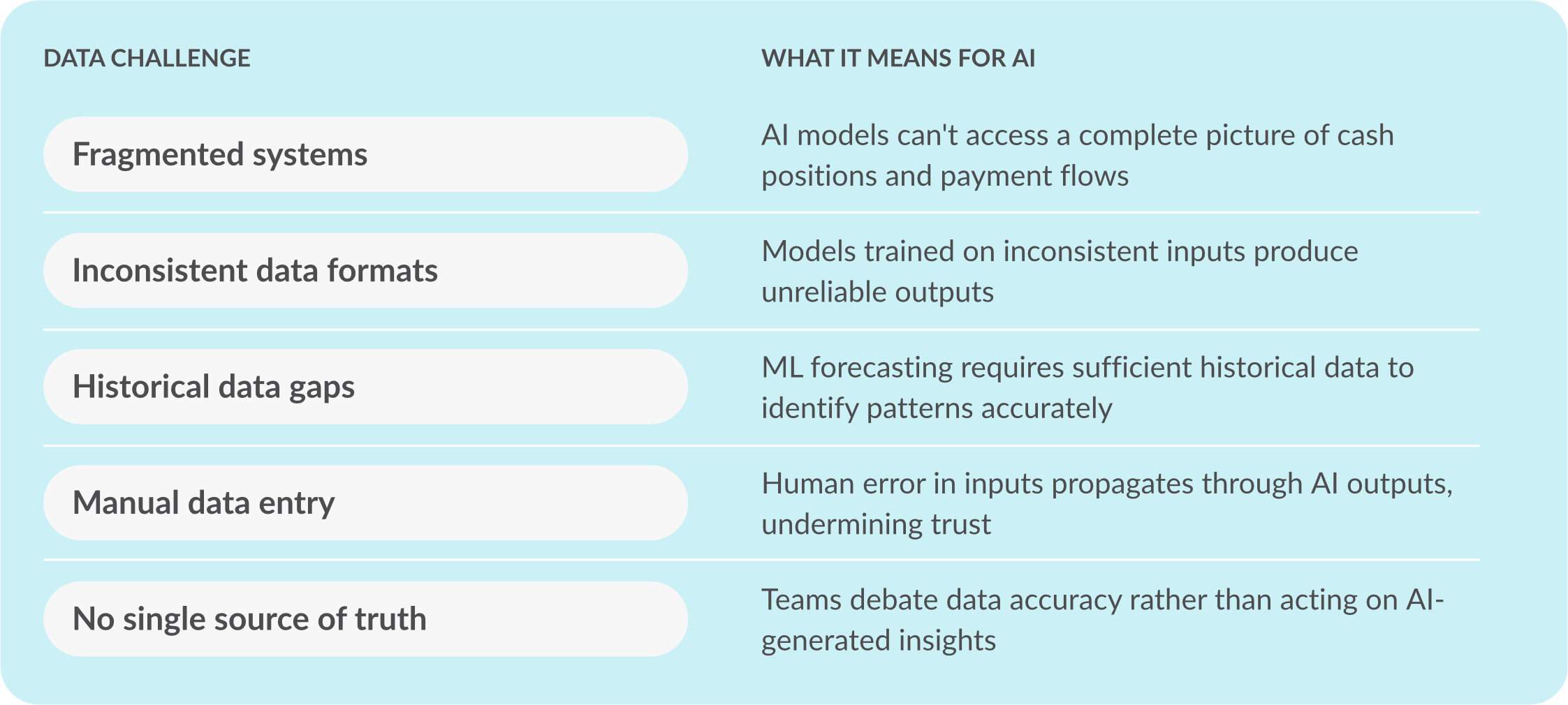
The practical implication is that before any treasury team invests in AI models, they should invest in connectivity. Real-time data exchange with banks and providers and standardized formats across systems are prerequisites — not optional enhancements.
"Your AI cash forecasting is only as good as the data underlying it. That's where treasury teams need to invest first." -Charles Bennett, Chief of Product, TIS
Foundation 2: Skills and AI fluency
The AI skills gap is consistently ranked as the biggest barrier to AI integration in enterprise organizations. But it's worth being precise about what this means for treasury specifically — because it isn't primarily about technical skills.
Most treasury teams don't need to understand how to build machine learning models. What they do need is:
- The ability to evaluate AI outputs critically: understanding when to trust a forecast and when to question it
- Understanding of industry context: Familiarity with the types of problems AI is and isn't suited to solve in a treasury context
- Comfort with AI-assisted workflows: knowing how to use tools effectively, not just passively receive outputs
- The human call: An understanding of where human judgment remains essential and how to exercise it alongside AI recommendations
Data Society’s 2025 AI Readiness Report shows that 65% of leaders don't know when or where to apply AI, and 52% lack a foundational understanding of how it works. In treasury, this translates directly to underutilization, with teams that have access to AI tools but don't use them confidently enough to change how they work.
The solution isn't a one-time training program. It's building continuous AI fluency into team development, starting with use cases that are immediately relevant — cash forecasting, variance analysis, scenario modeling — and expanding from there.
Foundation 3: Governance and trustThe trust dimension of AI adoption in treasury is frequently discussed but rarely acted on systematically. According to research published by EuroFinance (supported by TIS) titled ‘’AI in treasury - Accuracy, intelligence and the future of cash forecasting,’’ audit or governance concerns was cited as one of the biggest barriers to trusting AI-generated cash forecasts. For treasury specifically, governance means being clear about four things:
- Data boundaries: Which data can AI models access, and under what conditions?
- Decision authority: Which decisions can AI influence, and which require human sign-off?
- Auditability: How are AI-assisted decisions recorded, and can they be explained to auditors?
- Vendor accountability: What are the data isolation and security commitments of any AI platform used?
Organizations where senior leadership actively shapes AI governance consistently achieve greater business value than those delegating it entirely to technical teams. Governance isn't a constraint on AI adoption — it's what makes sustainable adoption possible.
C. The Treasurer's Evolving Role
One of the most persistent fears around AI in treasury is that automation will reduce the role of the treasury team, that if AI can forecast cash positions, build scenarios, and flag anomalies, there's less for a human treasurer to do.
The evidence points in a different direction. AI doesn't diminish the treasury function. It changes what it spends its time on — and, when deployed well, significantly elevates its strategic influence within the organization.
What defines the modern treasurer?The treasurer's role has been evolving for years, driven by increasing complexity in global payments, regulatory change, and growing executive demand for real-time financial visibility. AI accelerates that evolution rather than causing it. EY research shows that treasurers who collaborate closely with the C-suite are four times more likely to be involved in major business decisions. That involvement depends on treasurers having the time and the analytical tools to contribute strategic insight and not just operational reporting.
Today's treasury teams are expected to:
- Provide real-time visibility into global cash positions across multiple banks and currencies
- Model scenarios and stress-test liquidity under different market conditions
- Advise on working capital optimization and FX exposure management
- Support board-level risk discussions with data-driven analysis
- Operate as strategic partners to the CFO, not just financial custodians
None of these responsibilities are diminished by AI. Most of them become more feasible when AI handles the underlying data work.
What AI changes — and what it doesn't
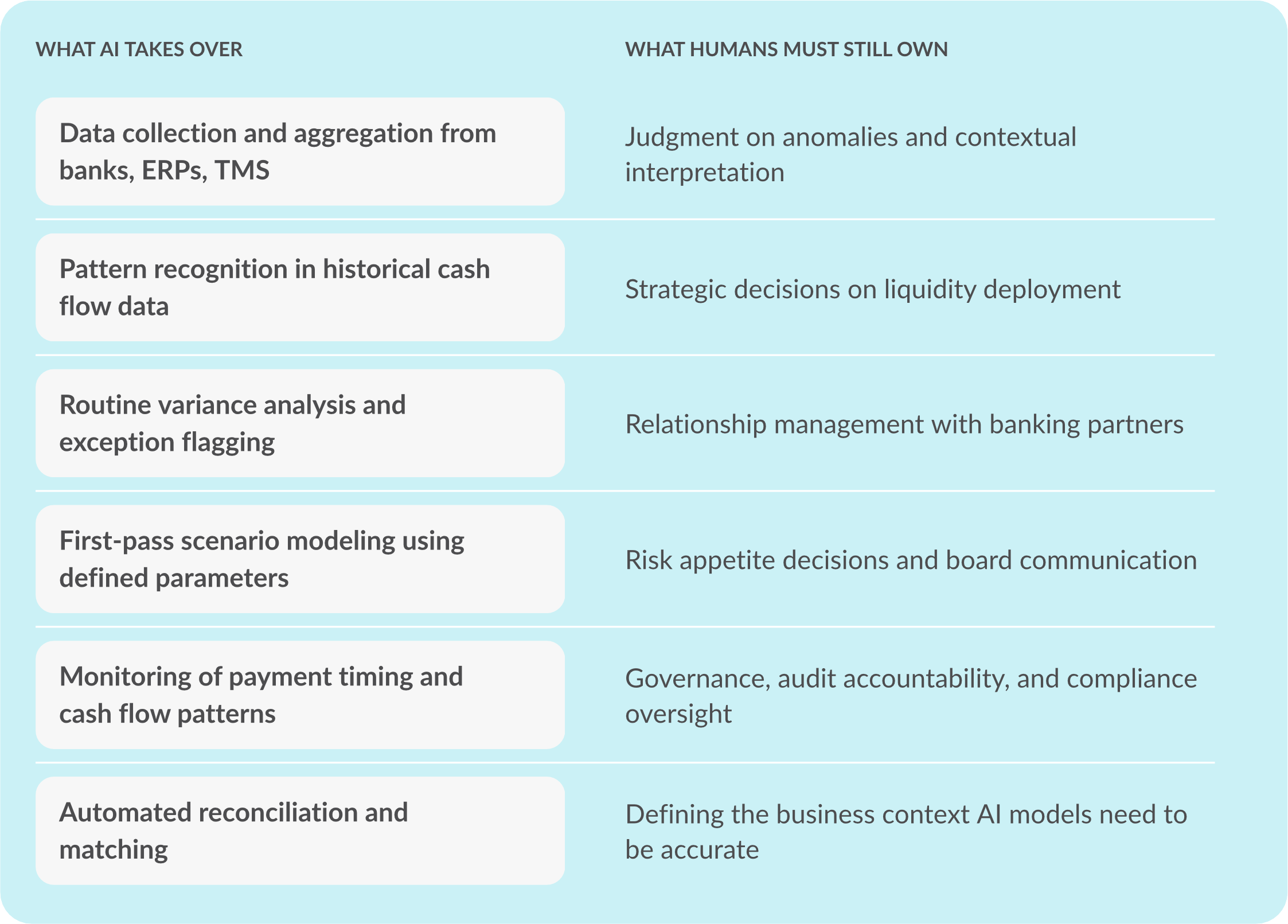
AI models for cash forecasting are only as accurate as the business context they're given. A treasurer who understands payment cycles, seasonal patterns, customer behavior, and operational drivers will configure and calibrate AI models far more effectively than one who treats them as a black box.
Trusting AI without surrendering judgmentThe right relationship with AI in treasury is neither uncritical acceptance nor reflexive skepticism. It's structured trust, that means knowing specifically where AI adds value, where its limitations lie, and how to maintain oversight.
This means building practices like:
- Regular variance reviews that compare AI forecasts against actuals, with root-cause analysis of significant deviations
- Defined escalation paths for cases where AI outputs fall outside expected ranges
- Clear documentation of which AI outputs influenced which decisions, for audit purposes
- Ongoing feedback loops that use those variance reviews to improve model inputs over time
Treasury teams that build these practices don't just use AI more confidently. They use it more effectively because structured oversight is also what drives model improvement.
D. AI in Cash Forecasting: What Good Looks Like
Cash forecasting is arguably the highest-impact, most mature AI use case in treasury today. It's where the evidence for AI's value is clearest, the technology is most proven, and the path from adoption to measurable outcome is most direct.
But it's also an area where confusion persists, particularly about what kind of AI is involved, what it actually does, and what preconditions are required for it to work well.
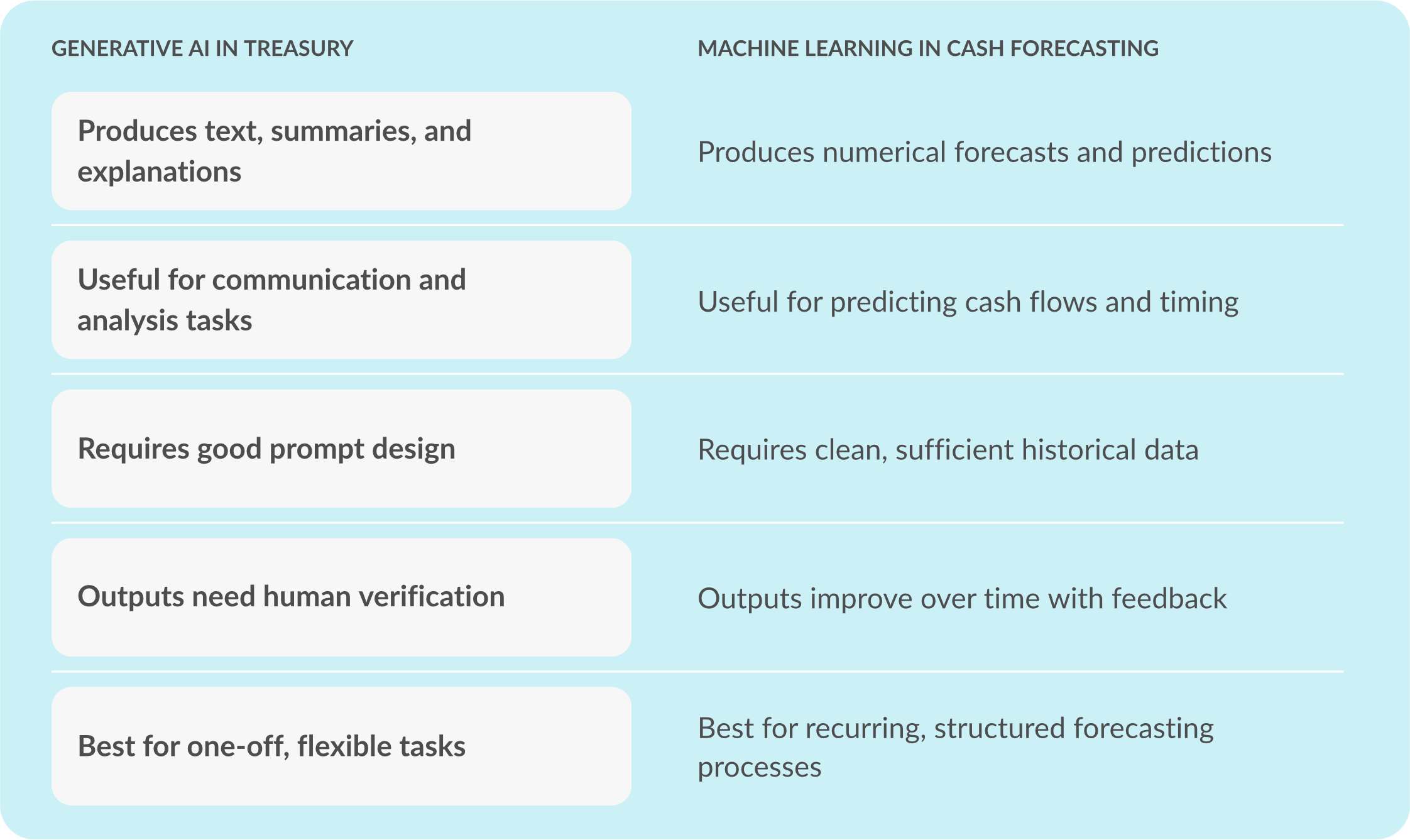
Generative AI vs. ML forecasting: An important distinction
When treasury professionals hear 'AI', they often think of generative AI — tools like ChatGPT that produce human-readable text in response to natural language inputs. Generative AI has genuine applications in treasury such as summarizing reports, drafting communications, answering queries about financial data, but it's not what drives forecasting accuracy.
Cash forecasting runs on machine learning — specifically, predictive models trained on historical financial data to identify patterns and project future cash positions. The distinction matters because the preconditions and appropriate uses for each are different.
What AI-driven forecasting actually delivers
When the data foundations are in place, AI-driven cash forecasting delivers across several dimensions that manual or rules-based methods cannot match.
Accuracy that improves over time
ML models analyze patterns across ERP data, historical payment behavior, seasonality, and external variables to produce forecasts that are continuously updated as new data comes in. EY research documents a 7% improvement in forecast accuracy when machine learning is adopted — and that gap tends to widen as models are refined.
Predicting cash flow timing, not just amounts
One of the most practically valuable capabilities of AI forecasting is predicting when payments will arrive or be made — not just in what amount. This matters for working capital optimization, short-term investment decisions, and avoiding unnecessary borrowing. Rules-based models use average payment terms; ML models learn actual payment behavior by counterparty.
Scenario and stress testing at scale
AI models allow treasury teams to run multiple scenario analyses simultaneously — modeling the cash flow implications of different market conditions, customer behavior changes, or operational disruptions. What previously required days of spreadsheet work can be done in hours.
Reducing manual effort
The time reclaimed from AI adoption is significant. Over 65% of treasury teams currently spend at least 20% of their time on non-value-added manual tasks. AI-driven forecasting directly addresses data aggregation, pattern analysis, and variance flagging — the tasks that consume most of that time.
Enhancing confidence at CFO and board level
When forecasts are generated by models with documented accuracy rates, updated in real time, and accompanied by clear explanations of the key drivers, CFOs and boards engage with them differently. Forecasting moves from a figure to be questioned to a foundation for strategic decision-making.
"AI forecasting doesn't just improve the numbers. It changes the conversation — from 'what are our cash positions?' to 'what should we do about them?"’ -Charles Bennett, Chief of Product, TIS
The barriers that remain
Even with a clear value case, treasury teams encounter consistent challenges in AI forecasting adoption. Being clear-eyed about these barriers is more useful than pretending they don't exist.
- Trust and explainability - Black-box models that produce accurate outputs but can't explain their reasoning create compliance and audit challenges. The solution is choosing platforms that provide model transparency and building variance review practices that build organizational trust over time.
- Data quality - As covered in Chapter 2, this is the foundational issue. AI forecasting with poor data inputs does not produce poor forecasts — it produces confidently wrong forecasts, which is worse. The investment in data quality must precede the investment in AI models.
- Integration with existing systems - Many treasury teams operate with a mix of legacy systems, bank formats, and ERP configurations that weren't designed to feed AI models. The connectivity infrastructure required — real-time API connections, standardized data formats — is solvable but requires explicit investment.
- Skills gap within treasury - As discussed in Chapter 2, teams need enough AI fluency to use forecasting tools actively rather than passively. This is a training and change management challenge as much as a technical one.
This is one of the most common questions from treasury teams considering AI forecasting, and the honest answer is: somewhat, but with significant limitations.
Modern ML models are more robust to data imperfections than earlier generations. They can handle some missing values, flag anomalies, and produce useful outputs even when historical data isn't perfect. But there are thresholds below which model quality degrades meaningfully.
The practical approach is a phased one: start with the highest-quality data available (typically bank statement data and ERP payment records), validate model outputs against known actuals, and systematically improve data inputs in parallel with model use. This builds confidence incrementally rather than requiring a perfect starting point.
E. How to Get Started
The path from AI-curious to AI-capable in treasury is rarely a single leap. It's a progression, through foundations, pilots, refinement, and scale. The teams that navigate it most successfully share a common approach: they start with conviction about outcomes, not enthusiasm about technology.
The AI readiness self-assessmentBefore investing in any AI platform or capability, treasury teams should be able to answer these questions honestly. The answers will shape both the prioritization and the sequencing of any AI initiative.
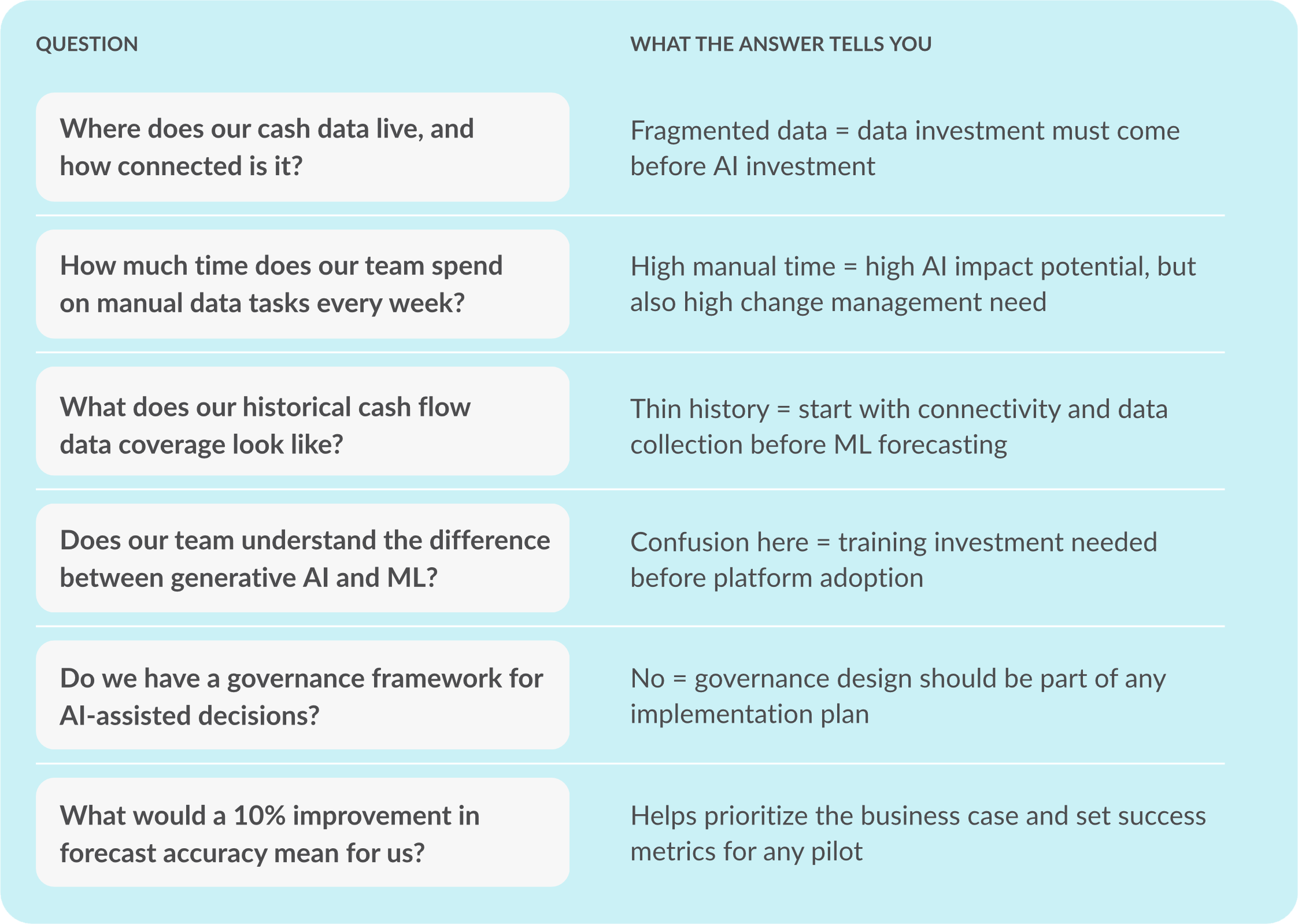
A practical starting sequence
Based on what works in practice, treasury teams making the most progress with AI tend to follow a similar sequence:
- Start with connectivity: Before AI, establish real-time data connections between your key systems — ERP, banking platforms, TMS. This is the infrastructure that everything else depends on.
- Identify one high-impact, high-frequency use case: Don't try to AI-transform treasury all at once. Choose the forecasting or reconciliation process that consumes the most time and has the clearest accuracy problem to solve.
- Define what success looks like before you start: Set specific targets — forecast accuracy improvement, time saved per week, reduction in manual touches — so you can evaluate whether the pilot is working.
- Invest in team fluency: Training shouldn't follow implementation. It should run alongside it, so the team is prepared to use and question AI outputs as soon as they're available.
- Build your governance frameworks early: Define data boundaries, decision authorities, and audit requirements before going live, not after an auditor asks for them.
- Review and refine systematically: Variance reviews between AI forecasts and actuals, conducted regularly, are the mechanism through which models improve. Build this practice from the start.
What to look for in an AI forecasting platform
Not all AI cash forecasting solutions are built on the same foundations. Treasury teams evaluating platforms should ask:
- Data isolation - Is client data kept in dedicated environments with no cross-tenant sharing or co-processing?
- Explainability - Can the platform explain why a forecast was generated — which inputs drove which outputs?
- Connectivity - How many bank connections does the platform support, and how does it handle ERP integration?
- Track record - Can the vendor demonstrate forecast accuracy improvements in comparable treasury environments?
- Human oversight design - Does the platform support the variance review and exception management practices that build organizational trust?
"The organizations that win with AI in treasury won't be those that adopted it first. They'll be those that built the foundations first — then scaled what worked." -Charles Bennett, Chief of Product, TIS
How TIS supports AI-ready treasury teams
TIS processes trillions in annual payment volume across 11,000+ bank connections — which means the data infrastructure that AI forecasting depends on is already built into the platform. Treasury teams using TIS can move faster on AI adoption because the connectivity, data standardization, and bank integration layers that most organizations spend months building are already in place.
TIS's AI-driven cash forecasting capability is designed around the principles in this guide: clean data inputs, transparent model outputs, human oversight built into the workflow, and continuous improvement through variance analysis. It's forecasting designed for treasury teams that want to use AI actively, not just passively receive outputs.
Ready to see what AI-ready cash forecasting looks like in practice?
Book a demo with TIS to explore how our platform supports treasury teams at every stage of the AI readiness journey.
About TIS
TIS helps CFOs, Treasurers, and Finance teams transform their global cash flow, liquidity, and payment functions. Since 2010, our award-winning cloud platform and best-in-class service model have empowered the entire office of the CFO to collaborate more effectively and attain maximum efficiency, automation, and control. TIS enables users to achieve superior performance in key areas surrounding cash forecasting, working capital, outbound payments, financial messaging, fraud prevention, payment compliance, and more.
For more information, visit tispayments.com and begin reimagining your approach to global cash flow, liquidity, and payments.